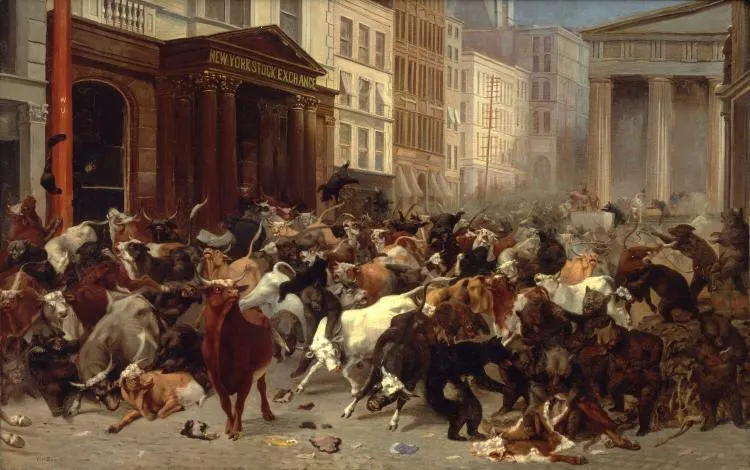
Bull market, bear market. For three centuries, the language of finance has pitted a bull against a bear. The choice isn't arbitrary, and one of the two origins is far better documented than the other.
The bear: selling the skin before the kill
In early eighteenth-century London, bearskin jobbers were dealers who sold bearskins they did not yet own. They counted on buying them back cheaper before delivery and pocketing the difference.
A proverb of the time mocked them: don't sell the bearskin before you have caught the bear. French kept almost exactly the same saying.
Today the mechanism has a name: short selling. You sell an asset you don't have, betting that its price will fall. The speculator betting on a fall naturally became a bear.
The bull: the animal set against it
The bull appears a little later, as the counterpart: the buyer betting on a rise. Why a bull? The origin is less certain.
The most common explanation is visual: a bull attacks by thrusting its horns upwards, a bear strikes with its paw downwards. Two gestures, two directions, like the two ways a chart can move. It's a vivid image, but it was most likely found after the fact. The pairing may also come from the animal fights popular at the time, in which bulls and bears were set against each other.
Words turned into statues
The vocabulary has survived centuries and screens. In 1989, sculptor Arturo Di Modica installed, without permission, a bronze bull weighing more than three tonnes near Wall Street. The city ended up keeping it: the Charging Bull is now one of New York's most photographed landmarks. Outside the Frankfurt stock exchange, a bull and a bear face each other.
What the vocabulary still says
Today, a market is said to enter bear territory when it falls at least 20% from its last peak, and to turn bullish again when it rises as much from its low. These are conventions, not laws: they name a trend, they don't predict one.
The chart has changed shape a hundred times. The animals stayed.
Margin trading carries a high risk of losing your capital, and cashback does not reduce that risk. RendR is not an investment adviser, manages no capital on behalf of its users, and never holds an account’s trading password. Cashback depends on the agreements reached with each partner broker.
Read the full risk warning